
CompTIA SecAI+ (CY0-001): What You Should Know About This Certification
There is a new certification on the market, and if you work in cybersecurity or AI, it deserves your attention. CompTIA SecAI+ (CY0-001) is the industry’s first credential built specifically at the intersection of artificial intelligence and cybersecurity, and the timing could not be more relevant. Let me explain what SecAI+ actually is, who it is for, and why it matters to your career.
SecAI+ is a vendor-neutral certification that validates your ability to work with AI systems from a security perspective. Vendor-neutral matters here: this is not a credential tied to OpenAI, Microsoft Azure, or any specific platform. The skills translate across open-source models, enterprise LLM deployments, cloud-based AI APIs, and everything in between.
What makes SecAI+ genuinely different from other certifications is its dual focus. On one side, it covers how to defend AI systems, which means protecting models from adversarial attacks, securing training data pipelines, and implementing access controls around AI APIs and agents. On the other side, it covers how to use AI as a security tool, including leveraging AI for threat detection, automating incident response workflows, and getting the most out of AI-powered tools in your SOC. No other certification puts both of those competencies into a single exam blueprint.
The exam code is CY0-001, and the format is straightforward: up to 60 questions, 60 minutes, passing score of 600 on a 100-to-900 scale. CompTIA recommends roughly 3-4 years of IT experience and 2 years of hands-on cybersecurity work before sitting for the exam. If you hold Security+, you are already in solid shape.
Let me explain what SecAI+ actually is, who it is for, and why it matters to your career.
SecAI+ is a vendor-neutral certification that validates your ability to work with AI systems from a security perspective. Vendor-neutral matters here: this is not a credential tied to OpenAI, Microsoft Azure, or any specific platform. The skills translate across open-source models, enterprise LLM deployments, cloud-based AI APIs, and everything in between.
What makes SecAI+ genuinely different from other certifications is its dual focus. On one side, it covers how to defend AI systems, which means protecting models from adversarial attacks, securing training data pipelines, and implementing access controls around AI APIs and agents. On the other side, it covers how to use AI as a security tool, including leveraging AI for threat detection, automating incident response workflows, and getting the most out of AI-powered tools in your SOC. No other certification puts both of those competencies into a single exam blueprint.
The exam code is CY0-001, and the format is straightforward: up to 60 questions, 60 minutes, passing score of 600 on a 100-to-900 scale. CompTIA recommends roughly 3-4 years of IT experience and 2 years of hands-on cybersecurity work before sitting for the exam. If you hold Security+, you are already in solid shape.
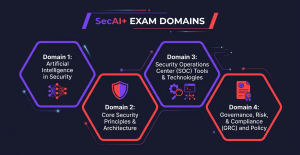 SecAI+ is organized into four domains.
Domain 1: Basic AI Concepts Related to Cybersecurity, makes up 17% of the exam. This foundation covers AI types, model architectures, training methodologies, and the AI lifecycle, and you need it before the rest of the content makes sense.
Domain 2: Securing AI Systems, is the heaviest domain at 40% of the exam. It covers threat modeling for AI systems, attack types like prompt injection and model poisoning, defensive architectures, guardrails, and monitoring. This is where the bulk of your study time should go.
Domain 3: AI-Assisted Security, accounts for 24% and covers how AI tools are used in the SOC, from automated threat hunting to SOAR integration and AI-powered penetration testing. It also covers how adversaries are weaponizing AI against organizations.
Domain 4: AI Governance, Risk, and Compliance, makes up the remaining 19%. This domain covers frameworks like the NIST AI Risk Management Framework, the EU AI Act, and OECD standards, along with the policy and risk management practices organizations need to govern AI deployments responsibly.
SecAI+ is organized into four domains.
Domain 1: Basic AI Concepts Related to Cybersecurity, makes up 17% of the exam. This foundation covers AI types, model architectures, training methodologies, and the AI lifecycle, and you need it before the rest of the content makes sense.
Domain 2: Securing AI Systems, is the heaviest domain at 40% of the exam. It covers threat modeling for AI systems, attack types like prompt injection and model poisoning, defensive architectures, guardrails, and monitoring. This is where the bulk of your study time should go.
Domain 3: AI-Assisted Security, accounts for 24% and covers how AI tools are used in the SOC, from automated threat hunting to SOAR integration and AI-powered penetration testing. It also covers how adversaries are weaponizing AI against organizations.
Domain 4: AI Governance, Risk, and Compliance, makes up the remaining 19%. This domain covers frameworks like the NIST AI Risk Management Framework, the EU AI Act, and OECD standards, along with the policy and risk management practices organizations need to govern AI deployments responsibly.
 The market data makes a compelling case for why this certification matters right now. According to LinkedIn Workforce Insights, AI and machine learning security job postings grew 112% between 2022 and 2025, more than double the growth rate of cloud security and nearly four times the growth rate of SOC analyst roles. AI security roles are also commanding a 15-to-30% salary premium over comparable traditional security positions, which reflects genuine scarcity in the talent pool.
The urgency is real on the risk side as well. 85% of enterprises have already experienced some form of AI-related security incident, whether that is a data leak through a generative AI tool, a model manipulated through adversarial inputs, or sensitive data exposed in a training pipeline. And by 2027, AI security is projected to become a board-level governance requirement in the same way data privacy became a C-suite issue after GDPR.
If you are a security analyst, SecAI+ gives you a framework for understanding how AI changes your threat landscape and what new controls you need to put in place. If you are an AI or machine learning engineer, it gives you the security vocabulary and adversarial mindset needed to build systems that do not introduce new attack surfaces. If you work in a SOC, it covers the AI-powered tools that are increasingly part of daily operations. And if your role touches governance, risk, or compliance, it covers the AI-specific regulatory frameworks that are starting to land in your lap. The certification maps to DoD 8570 and 8140 requirements, which matters for anyone working in government contracting or with federal agencies.
Learn more aboutl CompTIA SecAI+ video course series with instructor Dr. Michael Solomon. If you have been watching AI reshape the security landscape and wondering how to position yourself in it, this is a great place to start.
Talk to you next week!
The market data makes a compelling case for why this certification matters right now. According to LinkedIn Workforce Insights, AI and machine learning security job postings grew 112% between 2022 and 2025, more than double the growth rate of cloud security and nearly four times the growth rate of SOC analyst roles. AI security roles are also commanding a 15-to-30% salary premium over comparable traditional security positions, which reflects genuine scarcity in the talent pool.
The urgency is real on the risk side as well. 85% of enterprises have already experienced some form of AI-related security incident, whether that is a data leak through a generative AI tool, a model manipulated through adversarial inputs, or sensitive data exposed in a training pipeline. And by 2027, AI security is projected to become a board-level governance requirement in the same way data privacy became a C-suite issue after GDPR.
If you are a security analyst, SecAI+ gives you a framework for understanding how AI changes your threat landscape and what new controls you need to put in place. If you are an AI or machine learning engineer, it gives you the security vocabulary and adversarial mindset needed to build systems that do not introduce new attack surfaces. If you work in a SOC, it covers the AI-powered tools that are increasingly part of daily operations. And if your role touches governance, risk, or compliance, it covers the AI-specific regulatory frameworks that are starting to land in your lap. The certification maps to DoD 8570 and 8140 requirements, which matters for anyone working in government contracting or with federal agencies.
Learn more aboutl CompTIA SecAI+ video course series with instructor Dr. Michael Solomon. If you have been watching AI reshape the security landscape and wondering how to position yourself in it, this is a great place to start.
Talk to you next week!
 Let me explain what SecAI+ actually is, who it is for, and why it matters to your career.
SecAI+ is a vendor-neutral certification that validates your ability to work with AI systems from a security perspective. Vendor-neutral matters here: this is not a credential tied to OpenAI, Microsoft Azure, or any specific platform. The skills translate across open-source models, enterprise LLM deployments, cloud-based AI APIs, and everything in between.
What makes SecAI+ genuinely different from other certifications is its dual focus. On one side, it covers how to defend AI systems, which means protecting models from adversarial attacks, securing training data pipelines, and implementing access controls around AI APIs and agents. On the other side, it covers how to use AI as a security tool, including leveraging AI for threat detection, automating incident response workflows, and getting the most out of AI-powered tools in your SOC. No other certification puts both of those competencies into a single exam blueprint.
The exam code is CY0-001, and the format is straightforward: up to 60 questions, 60 minutes, passing score of 600 on a 100-to-900 scale. CompTIA recommends roughly 3-4 years of IT experience and 2 years of hands-on cybersecurity work before sitting for the exam. If you hold Security+, you are already in solid shape.
Let me explain what SecAI+ actually is, who it is for, and why it matters to your career.
SecAI+ is a vendor-neutral certification that validates your ability to work with AI systems from a security perspective. Vendor-neutral matters here: this is not a credential tied to OpenAI, Microsoft Azure, or any specific platform. The skills translate across open-source models, enterprise LLM deployments, cloud-based AI APIs, and everything in between.
What makes SecAI+ genuinely different from other certifications is its dual focus. On one side, it covers how to defend AI systems, which means protecting models from adversarial attacks, securing training data pipelines, and implementing access controls around AI APIs and agents. On the other side, it covers how to use AI as a security tool, including leveraging AI for threat detection, automating incident response workflows, and getting the most out of AI-powered tools in your SOC. No other certification puts both of those competencies into a single exam blueprint.
The exam code is CY0-001, and the format is straightforward: up to 60 questions, 60 minutes, passing score of 600 on a 100-to-900 scale. CompTIA recommends roughly 3-4 years of IT experience and 2 years of hands-on cybersecurity work before sitting for the exam. If you hold Security+, you are already in solid shape.
 SecAI+ is organized into four domains.
Domain 1: Basic AI Concepts Related to Cybersecurity, makes up 17% of the exam. This foundation covers AI types, model architectures, training methodologies, and the AI lifecycle, and you need it before the rest of the content makes sense.
Domain 2: Securing AI Systems, is the heaviest domain at 40% of the exam. It covers threat modeling for AI systems, attack types like prompt injection and model poisoning, defensive architectures, guardrails, and monitoring. This is where the bulk of your study time should go.
Domain 3: AI-Assisted Security, accounts for 24% and covers how AI tools are used in the SOC, from automated threat hunting to SOAR integration and AI-powered penetration testing. It also covers how adversaries are weaponizing AI against organizations.
Domain 4: AI Governance, Risk, and Compliance, makes up the remaining 19%. This domain covers frameworks like the NIST AI Risk Management Framework, the EU AI Act, and OECD standards, along with the policy and risk management practices organizations need to govern AI deployments responsibly.
SecAI+ is organized into four domains.
Domain 1: Basic AI Concepts Related to Cybersecurity, makes up 17% of the exam. This foundation covers AI types, model architectures, training methodologies, and the AI lifecycle, and you need it before the rest of the content makes sense.
Domain 2: Securing AI Systems, is the heaviest domain at 40% of the exam. It covers threat modeling for AI systems, attack types like prompt injection and model poisoning, defensive architectures, guardrails, and monitoring. This is where the bulk of your study time should go.
Domain 3: AI-Assisted Security, accounts for 24% and covers how AI tools are used in the SOC, from automated threat hunting to SOAR integration and AI-powered penetration testing. It also covers how adversaries are weaponizing AI against organizations.
Domain 4: AI Governance, Risk, and Compliance, makes up the remaining 19%. This domain covers frameworks like the NIST AI Risk Management Framework, the EU AI Act, and OECD standards, along with the policy and risk management practices organizations need to govern AI deployments responsibly.
 The market data makes a compelling case for why this certification matters right now. According to LinkedIn Workforce Insights, AI and machine learning security job postings grew 112% between 2022 and 2025, more than double the growth rate of cloud security and nearly four times the growth rate of SOC analyst roles. AI security roles are also commanding a 15-to-30% salary premium over comparable traditional security positions, which reflects genuine scarcity in the talent pool.
The urgency is real on the risk side as well. 85% of enterprises have already experienced some form of AI-related security incident, whether that is a data leak through a generative AI tool, a model manipulated through adversarial inputs, or sensitive data exposed in a training pipeline. And by 2027, AI security is projected to become a board-level governance requirement in the same way data privacy became a C-suite issue after GDPR.
If you are a security analyst, SecAI+ gives you a framework for understanding how AI changes your threat landscape and what new controls you need to put in place. If you are an AI or machine learning engineer, it gives you the security vocabulary and adversarial mindset needed to build systems that do not introduce new attack surfaces. If you work in a SOC, it covers the AI-powered tools that are increasingly part of daily operations. And if your role touches governance, risk, or compliance, it covers the AI-specific regulatory frameworks that are starting to land in your lap. The certification maps to DoD 8570 and 8140 requirements, which matters for anyone working in government contracting or with federal agencies.
Learn more aboutl CompTIA SecAI+ video course series with instructor Dr. Michael Solomon. If you have been watching AI reshape the security landscape and wondering how to position yourself in it, this is a great place to start.
Talk to you next week!
The market data makes a compelling case for why this certification matters right now. According to LinkedIn Workforce Insights, AI and machine learning security job postings grew 112% between 2022 and 2025, more than double the growth rate of cloud security and nearly four times the growth rate of SOC analyst roles. AI security roles are also commanding a 15-to-30% salary premium over comparable traditional security positions, which reflects genuine scarcity in the talent pool.
The urgency is real on the risk side as well. 85% of enterprises have already experienced some form of AI-related security incident, whether that is a data leak through a generative AI tool, a model manipulated through adversarial inputs, or sensitive data exposed in a training pipeline. And by 2027, AI security is projected to become a board-level governance requirement in the same way data privacy became a C-suite issue after GDPR.
If you are a security analyst, SecAI+ gives you a framework for understanding how AI changes your threat landscape and what new controls you need to put in place. If you are an AI or machine learning engineer, it gives you the security vocabulary and adversarial mindset needed to build systems that do not introduce new attack surfaces. If you work in a SOC, it covers the AI-powered tools that are increasingly part of daily operations. And if your role touches governance, risk, or compliance, it covers the AI-specific regulatory frameworks that are starting to land in your lap. The certification maps to DoD 8570 and 8140 requirements, which matters for anyone working in government contracting or with federal agencies.
Learn more aboutl CompTIA SecAI+ video course series with instructor Dr. Michael Solomon. If you have been watching AI reshape the security landscape and wondering how to position yourself in it, this is a great place to start.
Talk to you next week!