
How Long Does It Take to Go from Security to Cybersecurity?
 If you’ve passed Security+, you’ve already done the hardest part of becoming a cybersecurity analyst without knowing it.
Whether you are looking to up your skills for advancement at work, or you are looking to obtain the CompTIA CySA+ certification, the skills you need are outlined in CompTIA’s CySA+ Certification. Security+ built the foundation, threat concepts, cryptography, incident response, access control, and CySA+ turns that foundation into analyst-level application. The question isn’t whether Security+ gives you the foundation for becoming a cybersecurity analyst, but the question is how much additional time you actually need to apply those foundations to be able to learn the tools and analyze the data involved with cybersecurity.
The honest answer: 3 to 6 months of focused study for most Security+ holders.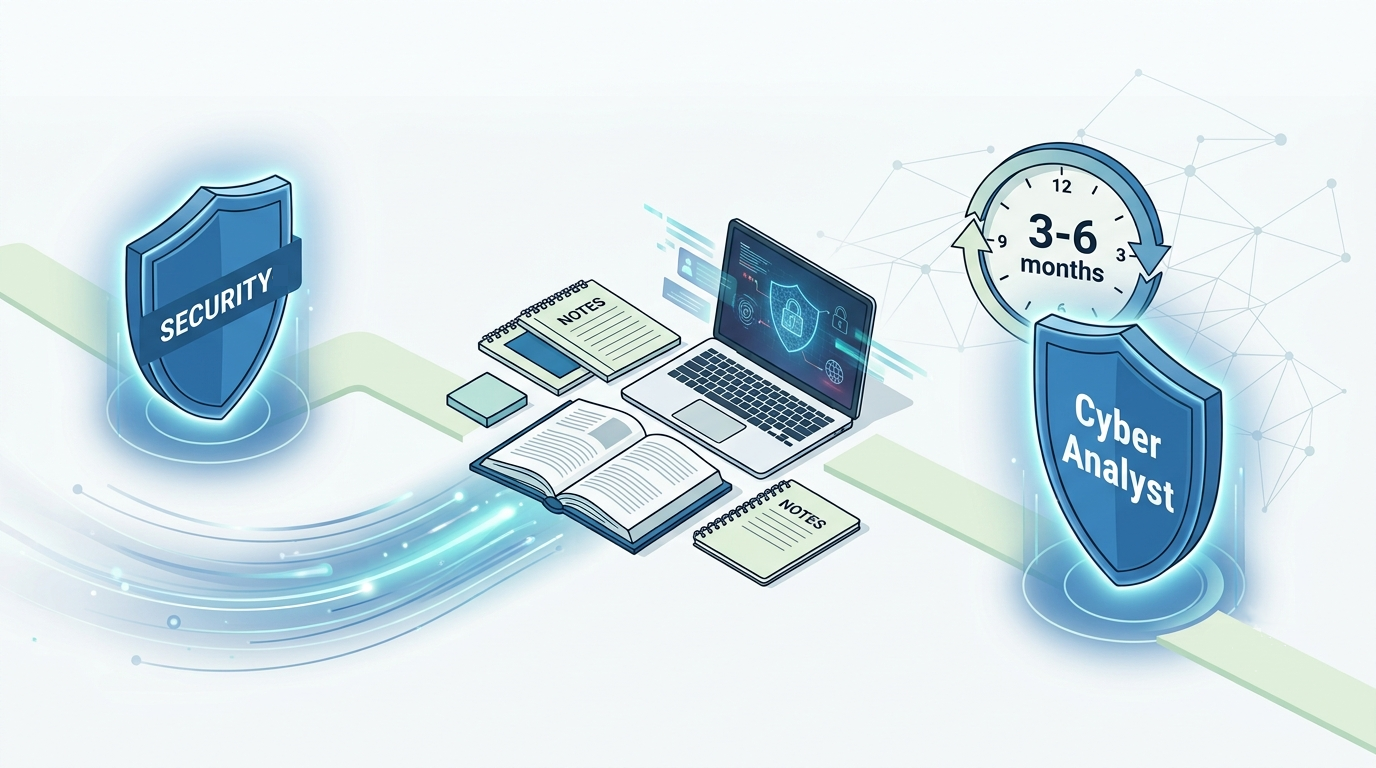
Why Security+ Already Covers CySA+ Ground
The CompTIA certification stack has become intentionally layered over the last few years. CySA+ CS0-004 doesn’t re-teach what Security+ covered, it builds on it. If you’ve studied threat actors, incident response phases, SIEM concepts, and vulnerability management for Security+, you already understand the foundation of the CySA+ security operations domain.
Security+ gives you the vocabulary. CySA+ makes you use it in context.
Here’s where the overlap is strongest:
Threat actors and attack frameworks. Security+ covers script kiddies, APTs, hacktivists, and insider threats. CySA+ picks up with MITRE ATT&CK, threat hunting, and indicator-of-compromise analysis. If you’ve done the Security+ work here, you’re not starting from zero.
Incident response. Security+ introduces the IR lifecycle: preparation, identification, containment, eradication, recovery, and lessons learned. CySA+ goes deeper, forensics, evidence handling, reporting, and post-incident communication. But the framework you learned in Security+ is the same one CySA+ builds on.
Vulnerability management. Security+ covers vulnerability scanning in broad strokes. CySA+ makes it a core competency, with CVSS scoring, scan configuration, remediation prioritization, and risk-based decision-making.
Authentication and access control. Same concepts, deeper context. Security+ introduces IAM principles; CySA+ applies them to enterprise security operations.
Where the Real Gap Is
CySA+ goes significantly deeper in three areas that Security+ only touches:
Security information and event management (SIEM). Security+ mentions SIEM as a concept. CySA+ expects you to analyze SIEM output, correlate events, and triage alerts. This is the biggest skill gap for most Security+ holders, and where you’ll spend the most study time.
Threat intelligence. CySA+ introduces structured threat intelligence: cyber threat intel platforms, indicator enrichment, OSINT, intelligence cycles. Security+ doesn’t cover this depth.
Reporting and communications. CySA+ is an analyst cert. Analysts write reports, brief leadership, and communicate findings. There’s a full domain on reporting, something Security+ doesn’t address.
What the Analyst Role Actually Looks Like
It helps to remember why this certification exists. CySA+ validates the day to day work of a security analyst: sitting in front of a console, watching alerts, deciding which ones matter, and running down the ones that do. That is a different muscle than knowing definitions. Security+ proves you understand the concepts. CySA+ proves you can act on them under pressure, with incomplete information, on a real timeline. If your goal is an analyst seat in a security operations center, the study you do here maps directly onto the job you want.
The Realistic Timeline
For an active Security+ holder:
Month 1/2: Focus on SIEM operation, threat intelligence, and log analysis. These are the biggest gaps.
Month 3/4: Vulnerability management deep dive, including CVSS and remediation workflows.
Month 4/5: Incident response mastery, forensics basics, and practice questions.
Month 6:Full practice exams, domain review, and exam scheduling.
The single most effective thing you can do is get hands-on early. Reading about a SIEM teaches you what it is. Working with real log data, writing a query, and chasing down a false positive teaches you what the exam and the job both actually test. Build practice time into your schedule from week one, not as an afterthought right before the exam.
The Bottom Line
Security+ to cybersecurity analyst is not a giant leap. It’s a structured step for someone who did the Security+ work correctly. The knowledge transfers. The skills build. The timeline is real but manageable and varies depending on how much time you can commit to regularly study.
If you’re asking how long it takes, the more important question is: how serious are you about doing the work? The concepts are laid out in CySA+, the time involved is taking those concepts and putting the time in to work with the tools and data. It takes regularly scheduled practice to be successful, set aside the time each week and stay on schedule, and you will be ready in three to six months.
Talk to you next week.
If you are studying for CySA+ on Coursera, check out our CySA+, Course 2: Threat Intelligence and Security Tools, Module 2 covers SIEM operation and packet analysis at exactly the depth CySA+ expects, one module at a time.