
CompTIA Security+ Domains Explained: How Each One Maps to Real Cybersecurity Jobs
 If you’ve been looking at the CompTIA Security+ SY0-701 exam and wondering what those five domain names actually mean for your career, you’re asking exactly the right question. The domains aren’t just boxes to check on the way to passing a test. They’re a framework, description of what cybersecurity professionals actually do every day, broken down by the skills employers are paying for right now. Understanding them won’t just help you pass the exam. It will help you walk into an interview and speak fluently about the work.
Start with the numbers, because they tell you a lot. General Security Concepts makes up 12% of the exam. Threats, Vulnerabilities, and Mitigations is 22%. Security Architecture comes in at 18%. Security Operations is the biggest at 28%, nearly a third of the entire exam. And Security Program Management and Oversight rounds things out at 20%. Those percentages aren’t arbitrary. CompTIA weighted each domain based on how much of your actual working time you’ll spend on those tasks once you’re hired. The exam is practically a job description.
Domain 1, General Security Concepts, covers the vocabulary and foundational thinking that runs through everything else. Security controls, the mechanisms we use to reduce risk—are central here. There are managerial controls, which are the policies and procedures that define what should be done. Operational controls govern how often those things get done. Technical controls are the actual tools and configurations that implement them. In the real world, a systems administrator choosing between a firewall rule and a software patch is making a technical control decision. A manager scheduling a quarterly security audit is exercising an operational control. Knowing this vocabulary cold means you can speak the language of every security team you’ll ever work with.
 Domain 2, Threats, Vulnerabilities, and Mitigations, is where you learn to think like an attacker so you can defend like a professional. Vulnerability assessment is a core skill here. Before attackers can exploit a weakness, they have to find it, and so do you. Vulnerability scanning is considered a passive activity: you’re probing and cataloging, not exploiting. That distinction matters because it defines the legal and professional boundary between a vulnerability assessor and a penetration tester. Many entry-level security analysts spend the majority of their time running and interpreting vulnerability scans. Being fluent in this domain means being ready for that work on day one.
Domain 3, Security Architecture, asks how you design systems to be secure from the ground up. This is where concepts like security zones, network segmentation, and resilience planning live. It also covers cloud security, software-defined networking, and how to build infrastructure that can detect and recover from incidents rather than simply hoping they don’t happen. For anyone aiming toward a cloud security or enterprise architect role, this domain is the foundation of the technical conversations you’ll have in every senior job interview.
Domain 4, Security Operations, is the biggest domain for a reason. This is the day-to-day work of cybersecurity—and identity management sits right at the center of it. The concept of identification, authentication, and authorization (IAA) is one of the most universally applied skill sets in IT security. Identification answers the question: who are you? Authentication answers: can you prove it? And authorization determines: what are you allowed to do? Whether you’re configuring Active Directory, managing role-based access in a cloud environment, or reviewing an access control audit, you’re working within this framework every single day. Understanding IAA conceptually is what lets you apply it across any platform or tool you encounter.
Domain 5, Security Program Management and Oversight, is where security meets the business. This is about governance, compliance, risk management frameworks, and third-party risk, which has become one of the most pressing concerns in modern cybersecurity. In today’s interconnected environment, your organization’s security is only as strong as the weakest vendor in your supply chain. A partner’s unpatched server or a contractor without proper security training can become the entry point for an attacker targeting your organization. Learning how to evaluate third parties, conduct due diligence, and implement governance policies is exactly what separates a junior analyst from a security manager. Domain 5 teaches you to think at that level.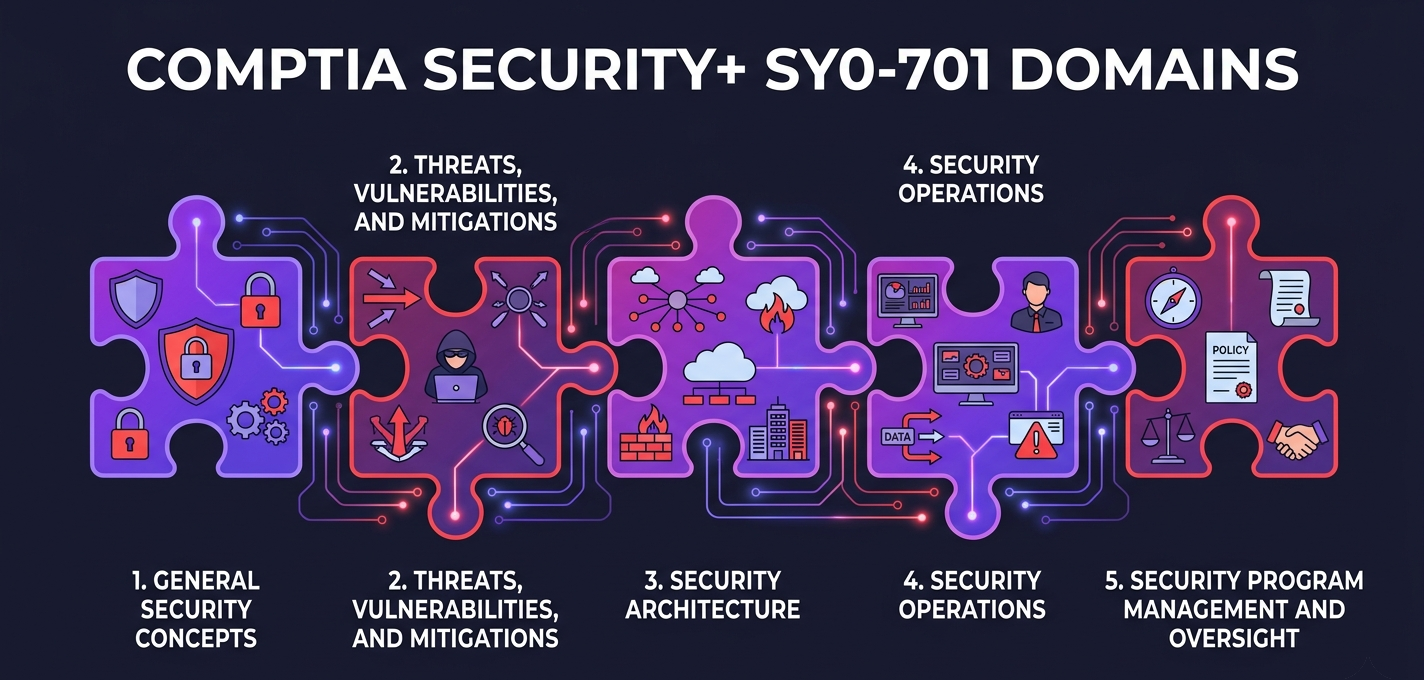
Taken together, the five Security+ domains give you a complete picture of what it means to work in cybersecurity, not as a series of abstract concepts, but as a set of concrete skills tied to real job functions. When you understand how the domains relate to actual work, studying becomes more purposeful and interviews become more natural. You’re not just memorizing content for an exam. You’re building a career framework that will serve you for years after the cert is on your resume.
Talk to you next week!