
PenTest Basics: What You Need to Know

Penetration testing, or pentesting, is the practice of legally and intentionally simulating an attack on a system, network, or application to find vulnerabilities before real attackers do. Organizations hire penetration testers, and sometimes conduct tests with their own staff, to get an honest picture of how well their defenses hold up. The goal is not to cause damage. The goal is to find the gaps before someone else does.
Understanding pentesting matters even if you never plan to become a penetration tester. Security administrators, network engineers, and help desk professionals who understand how attackers think and work are dramatically better at building and maintaining defenses. The attacker mindset, seeing your own environment as a target, is one of the most valuable shifts a security-conscious IT professional can make.
Penetration testing follows four basic phases. The first is reconnaissance, or recon, the information-gathering phase that happens before any active tool touches the target network. Recon can be passive, gathering information from public sources without directly interacting with the target, or active, probing the target directly to collect data. The second phase is scanning, where tools like Nmap map open ports, running services, and OS versions to build a picture of the attack surface. The third phase is exploitation, attempting to use a discovered vulnerability to gain access within the defined scope of a written authorization. The fourth phase is reporting, documenting what was found, how it was found, the potential impact, and the remediation steps.
Nmap is the tool most professionals encounter first in the scanning phase. It identifies which hosts are reachable on a network, which ports are open, and in many cases which services and operating systems are running. A pen tester uses this output to build a map of the attack surface. Every open port becomes a question: is this supposed to be here, and is it configured securely? The scanning phase does not cause damage. It observes. But those observations are what make the next phase possible.
The exploitation phase carries the most legal and ethical weight. Attempting to exploit a system without written authorization is illegal. Legitimate penetration testing always begins with a rules of engagement document that defines the scope, the methods permitted, and the systems in scope. Without it, even using a port scanner against a network you do not own can cross a legal line. This cannot be overstated: authorization is not optional.
The reporting phase is where the business value of a pentest is realized. A penetration test that does not produce a clear, actionable report has not done its job. Good pentest reports are written for two audiences: technical staff who need to understand the specific vulnerability and how to remediate it, and leadership who need to understand the business risk. The most common failure in pentest engagements is a technically detailed report that no one outside the security team can act on.
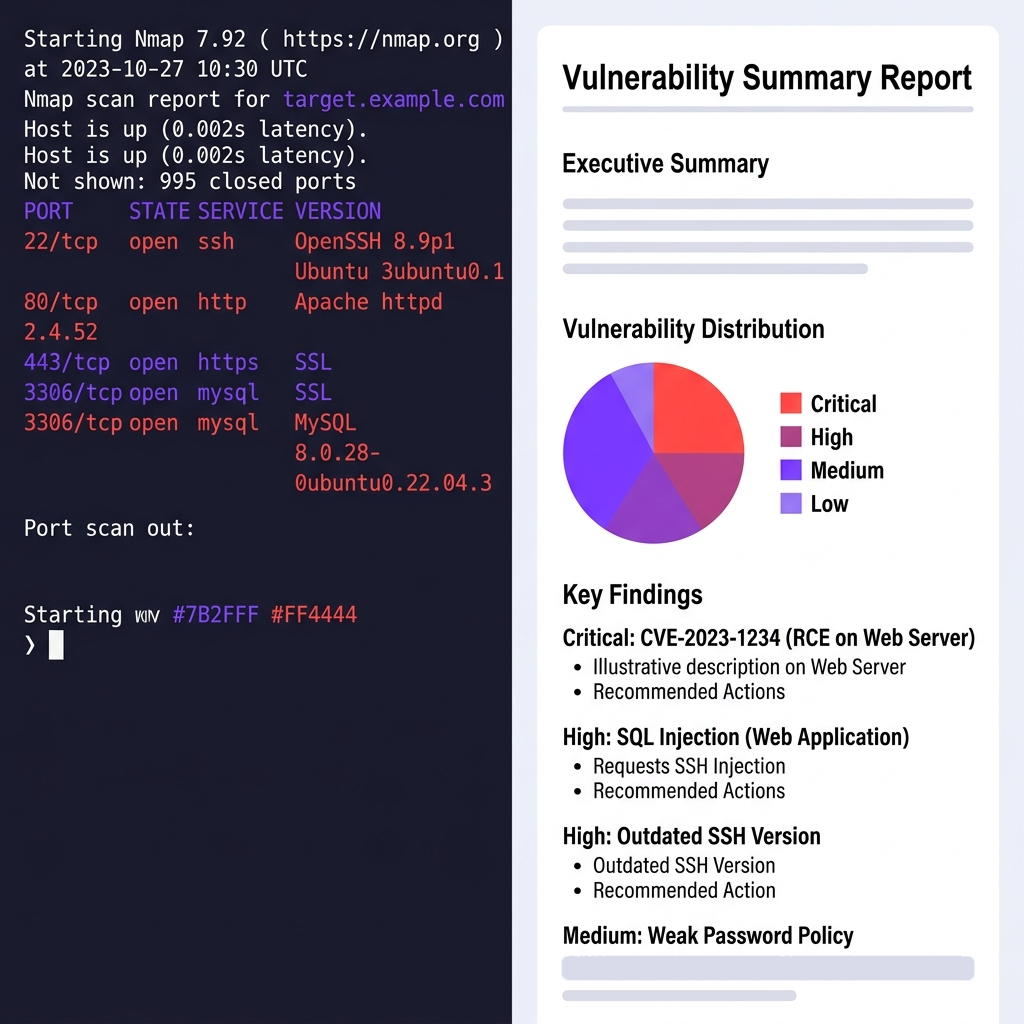 The two tools that come up earliest in any introduction to pentesting are Nmap and Wireshark. Nmap handles host discovery and port scanning. Wireshark is a packet analyzer that captures live network traffic and lets you inspect individual packets at the protocol level. Where Nmap tells you what is running and listening, Wireshark tells you what is being transmitted. Both tools are free, widely documented, and available on most Linux distributions. Both are also covered on the CompTIA PenTest+ and CEH exams.
Getting started with pentesting means building a lab. TryHackMe and Hack The Box both provide guided lab environments where you can run scanning and exploitation exercises against intentionally vulnerable systems without any legal risk. These platforms map their content to certification objectives, which makes them strong preparation tools for CompTIA PenTest+ and CEH alongside formal study materials.
The most important shift to make early is learning to see your own environment the way an attacker would. Every open port, every misconfigured service, and every default credential becomes visible in a different way once you have run a scan on your own lab and asked the question: if this were a target, where would I start? That question is the beginning of a much stronger security posture.
Talk to you next week!