
Your First Line of Defense: Network Security Skills Every IT Pro Needs
 If you work in IT and you have not yet started building your network security skill set, now is the time. Not because a certification tells you to, and not because your boss said so. Because the skills we are about to cover are the ones that show up in real incidents, real audits, and real job interviews, whether you are in a helpdesk role today or targeting a security analyst position next year.
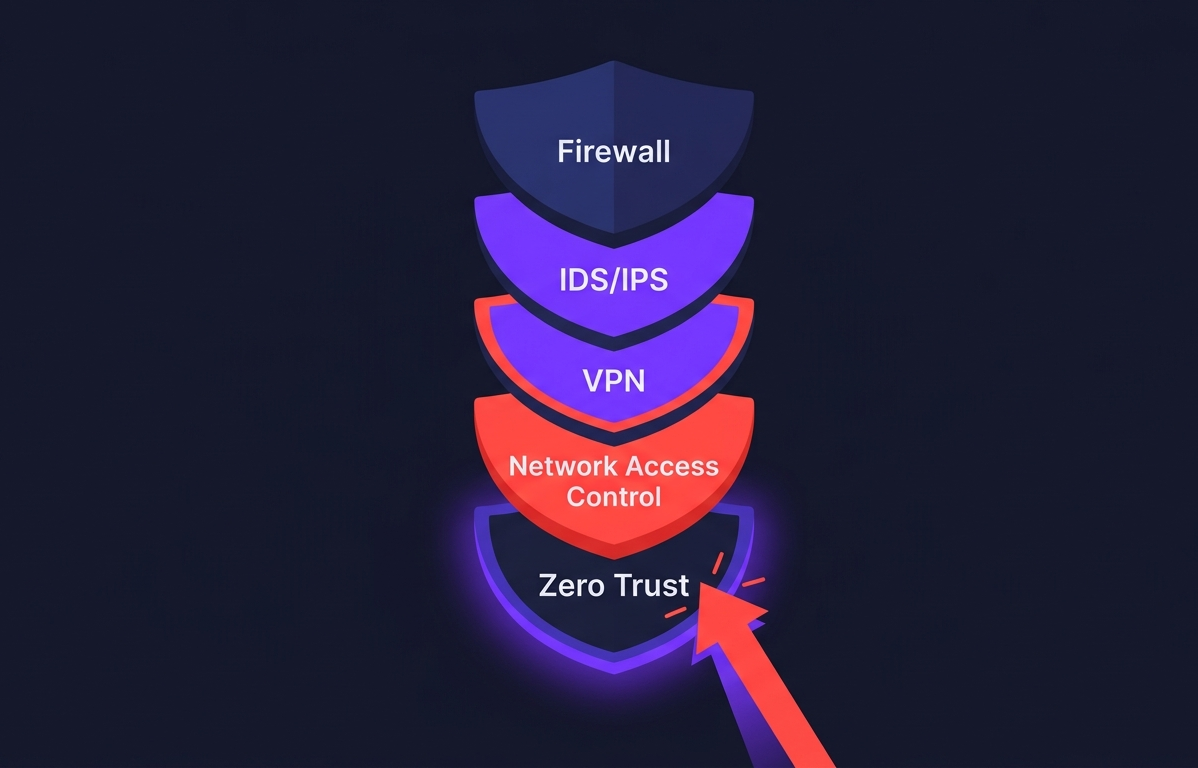
This week we are covering five skills that form the foundation of network security. These are not esoteric concepts reserved for specialists. They are the tools and techniques that protect every network, in every organization, every single day.
 Firewalls: The Rule Book for Your Network
A firewall is the most fundamental tool in network security. It sits between your network and the outside world, making decisions about what traffic is allowed in and what gets blocked. Those decisions are based on rules you configure, called access control lists or ACL rules. They can filter traffic by IP address, protocol, port number, and more.
Most IT pros encounter firewalls early in their career. The mistake is treating them as a set-it-and-forget-it tool. Firewalls require ongoing review. Rules accumulate over time, old policies get left in place, and gaps appear. Understanding how packet filtering and stateful inspection work is what lets you maintain a firewall intelligently, not just enable it and move on.
IDS and IPS: The Network Is Always Talking. Are You Listening?
Intrusion detection systems and intrusion prevention systems are designed to watch your network continuously and flag suspicious activity. The difference between them comes down to what happens when something gets flagged. An IDS alerts. An IPS can also take action to block the traffic in real time.
Most breaches are not sudden explosions. They are slow, quiet movements through a network, looking for the next foothold. IDS and IPS exist to catch those movements early. Tuning them for your specific environment is critical, because what looks suspicious on one network might be normal traffic on another. Reducing false positives is part of the skill.
VPNs: Protecting Traffic That Has to Leave Your Network
A virtual private network creates an encrypted tunnel between two points. When traffic passes through that tunnel, it is protected even if the underlying network is untrusted, such as public Wi-Fi or the open internet. This is how remote workers access internal systems securely, and how branch offices connect to headquarters without exposing traffic to interception.
Understanding how VPNs work matters beyond just clicking a connect button. IPsec, TLS-based VPNs, client-to-site versus site-to-site configurations: these distinctions affect how you deploy, troubleshoot, and secure remote access in a real environment.
Network Access Control: Not Everyone Belongs on Your Network
Network access control, or NAC, is about making sure only authorized, compliant devices connect to your network in the first place. Before a device is allowed on, a NAC policy can check its operating system type, location, whether it has a host-based firewall active, and whether anti-malware tools are current and running.
This matters because attackers do not always come in through the front door. They bring in a device, plug it into a port, and start moving laterally. NAC puts a checkpoint at the point of entry. It is not a perfect solution on its own, but as part of a layered approach, it significantly raises the cost of that kind of attack.
Zero Trust: Stop Trusting. Start Verifying.
Zero Trust is not a product you can buy. It is a framework built on one principle: never trust, always verify. That means no device, no user, and no connection is trusted by default, even if they are already inside your network. Every access request is evaluated based on identity, device health, location, and behavior.
Zero Trust has moved from a theoretical model to a practical expectation in enterprise environments. If you are heading into a security role, you will encounter it. Understanding its core concepts, even before you design an architecture around it, puts you ahead of most candidates walking into a security interview.
 Building Your First Line of Defense
These five skills are foundation, not a ceiling. Understand how firewalls make decisions, how IDS systems detect anomalies, how VPNs protect traffic in transit, how NAC enforces access policy, and how Zero Trust changes the trust model entirely, the better positioned you are to take on a security role, pass a security exam, or protect the network you already manage.
Start with one skill. Get hands-on with it this weekend.
Talk to you next week!